
Basketball Betting Basics: Account Setup and Match Odds
 Available in US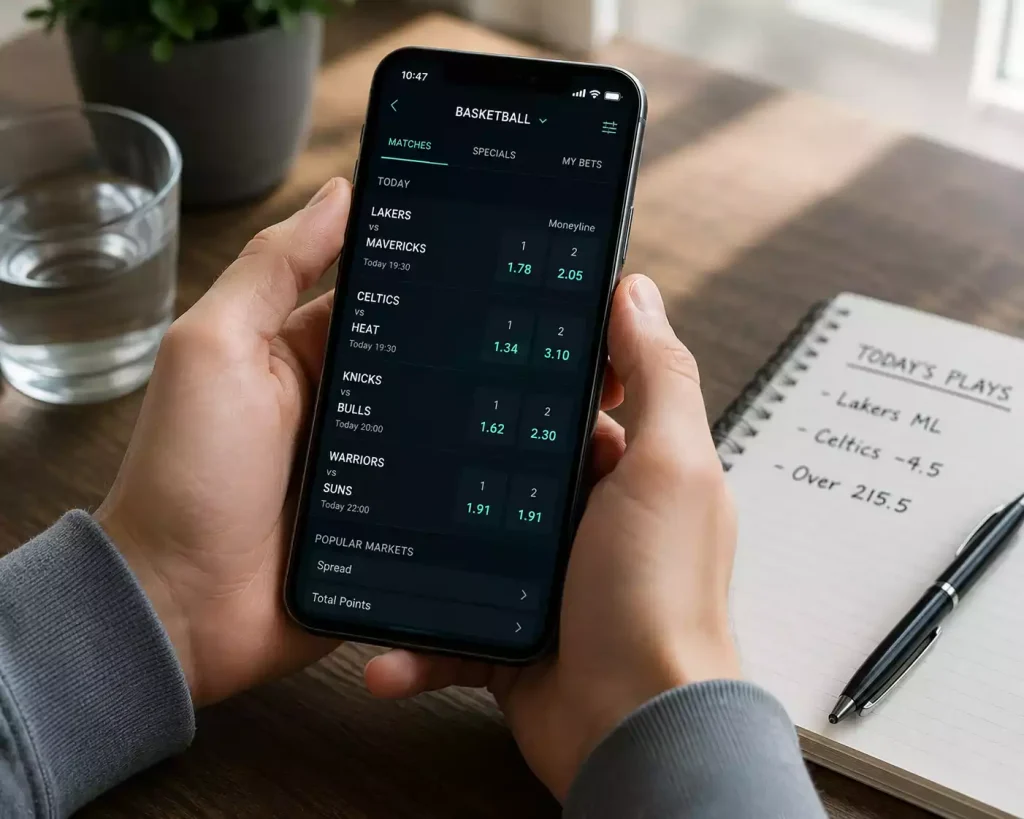
I remember my first basketball bet like I remember my first bad haircut — vividly, and with a lingering sense that I could have done some basic preparation beforehand. It was a Lakers game, I had no idea what a spread was, and I clicked something that turned out to be a player prop on assists. The bet lost, but worse, I had no understanding of why I’d placed it in the first place. That was eleven years ago. If you’re reading this, you’re already ahead of where I started, because you’re actually looking things up before handing over money.
Basketball betting in the UK sits in a different spot compared to football or horse racing — it’s growing fast but still flies under the radar for many punters. About 10% of the UK population places online sports bets, generating 290 million wagers every single month, yet basketball remains one of the most under-explored sports on UK betting slips. That’s partly an opportunity. The markets are there, the coverage is solid, and the learning curve is genuinely manageable once someone walks you through the basics.
This guide is built for someone placing their first basketball bet. No assumptions about prior knowledge, no jargon without explanation, no shortcuts that leave you confused at the bet slip. I’ll walk through everything from setting up an account to understanding what the numbers on your screen actually mean — and the mistakes that cost beginners money before they’ve even started learning.
Account Registration Requirements for UK Punters
The first betting account I ever opened took three days to verify because I submitted a blurry photo of my driving licence. These days, most UK-licensed bookmakers can verify you within minutes — but there’s a specific checklist you need to tick before you can place a single wager.
Every legitimate sportsbook operating in the UK holds a licence from the Gambling Commission. That’s non-negotiable. Before you type your card details into any site, check the footer for a licence number, or search the Commission’s public register directly. If a site isn’t listed, walk away — no matter how appealing the sign-up offer looks.
To open an account, you’ll need to be 18 or older and provide proof of identity. Standard documents include a passport, driving licence, or national identity card. Most operators also require proof of address — a utility bill or bank statement dated within the last three months. The verification process, known as KYC (Know Your Customer), exists because of anti-money laundering regulations, not because the bookmaker is being nosy. Once verified, you can deposit funds via debit card, bank transfer, or e-wallets. Credit card deposits have been banned in the UK since April 2020, which was a regulatory move specifically designed to prevent people from betting with borrowed money.
Set a deposit limit before you put any money in. Every UK-licensed operator is required to offer this tool, and it’s the single most useful feature for a beginner. Pick a weekly or monthly figure you’re comfortable losing entirely — because that’s the realistic framing. This isn’t an investment account. It’s entertainment with a mathematical edge favouring the bookmaker, and your deposit limit is the price of the ticket.
Placing Your First Basketball Bet: A Walkthrough
47% of UK adults participate in some form of gambling, with 15% of men placing sports bets — but a surprising number of them have never ventured beyond football. Basketball is a different animal, and the process of placing a bet reflects that. Here’s how it actually works, step by step.
Log into your verified account and navigate to basketball. Most bookmakers list it under “Sports A-Z” or feature it prominently during the NBA season. You’ll see a list of upcoming games, each displaying a set of numbers next to team names. These numbers are the odds, and they tell you how much you’d win relative to your stake. In the UK, odds are usually displayed in decimal format by default — so 1.50 means you get back £1.50 for every £1 staked (your original pound plus 50p profit). Fractional odds like 1/2 show the same thing differently: for every £2 you stake, you’d profit £1.
Click on the outcome you want to back. This adds it to your bet slip — that panel usually sitting on the right side of the screen or at the bottom on mobile. Enter your stake: how much you want to risk on this bet. The slip will show your potential return, calculated by multiplying your stake by the decimal odds. A £10 bet at 2.00 returns £20 (£10 profit). A £10 bet at 1.40 returns £14 (£4 profit). The lower the odds, the more likely the bookmaker thinks that outcome is — but the less you’ll win.
Before you hit confirm, double-check three things. First, you’ve selected the right game — during busy NBA nights, it’s easy to accidentally back the wrong team. Second, your stake is what you intended, not a digit more or less. Third, the market type matches your intention. If you wanted to bet on which team wins the game outright, make sure you’re on the moneyline or match result market, not the point spread or totals. For a detailed breakdown of every basketball betting market available in the UK, that’s worth reading once you’ve placed your first couple of bets.
Hit “Place Bet.” That’s it. The bet is live. Your account balance drops by the stake amount, and you wait for the game to finish. Results are usually settled within minutes of the final buzzer, and any winnings are credited to your account automatically.
Reading Basketball Odds for the First Time
A mate once told me he avoided basketball betting because “the numbers looked like a maths exam.” Fair enough — but once you understand the logic, it takes about five minutes to decode any basketball odds screen in the UK.
Decimal odds are the standard at most UK bookmakers. The number you see is your total return per pound staked. An outcome priced at 3.00 means £3 back for every £1 wagered — that’s £2 profit plus your original stake. An outcome at 1.25 means just 25p profit on every pound. The crucial insight: lower decimals mean higher implied probability. Odds of 1.25 imply an 80% chance (1 divided by 1.25), while odds of 3.00 imply roughly 33%.
Fractional odds work differently but say the same thing. Odds of 5/1 mean you profit £5 for every £1 staked. Odds of 1/5 mean you profit £1 for every £5 staked. The first number is your potential profit, the second is your stake. Most UK sportsbooks let you toggle between decimal and fractional in your account settings — pick whichever clicks faster for you, though decimal is generally easier for quick mental arithmetic.
American odds show up occasionally on UK platforms, especially for NBA-focused markets. A positive number like +200 tells you the profit on a £100 stake (so £200 profit). A negative number like -150 tells you how much you’d need to stake to profit £100 (so you’d need to risk £150). These are less intuitive for UK punters, and I’d recommend sticking with decimal unless you’re specifically working with American-format analysis tools.
The key concept connecting all three formats is implied probability — the bookmaker’s estimate of how likely an outcome is, baked into the price. But here’s the thing bookmakers don’t advertise: the implied probabilities for all outcomes in a market always add up to more than 100%. That gap, typically between 3% and 8% for basketball, is the overround — the bookmaker’s built-in profit margin. Understanding that margin exists is the first real step toward thinking about betting analytically rather than just picking winners.
Five Mistakes New Basketball Bettors Make
I’ve made every single one of these. Some of them more than once. They’re the tax you pay for learning without guidance, and the whole point of listing them here is so you don’t have to pay it.
The first mistake is betting on every game. The NBA alone plays 1,230 regular season games, and it’s tempting to have action on all of them. Don’t. Selectivity is the entire foundation of any approach that doesn’t just bleed money. Start with one or two games per week — enough to learn the rhythm without turning your account into a slot machine.
Second: ignoring the time zone. NBA games tip off between 11pm and 3:30am UK time on most nights. Live betting on a game at 1am when you’re half asleep is a recipe for poor decisions. If late-night betting doesn’t suit your schedule, pre-match markets close before tip-off, and EuroLeague games run in the early evening GMT — much more compatible with a normal UK routine.
Third: chasing losses. You lose two bets, so you double the stake on the third to “get it back.” This is how bankrolls evaporate. Every bet should be a standalone decision, sized according to a plan you set before the night started, not a reaction to what just happened.
Fourth: not checking which market you’re actually betting on. I once thought I’d backed the Boston Celtics to win, only to discover I’d placed a bet on the first-quarter spread. Basketball betting slips have dozens of markets per game, and it takes one careless tap to end up in the wrong one. Scroll up, read the market name, confirm the selection.
Fifth: treating odds as predictions. Odds reflect where the money is flowing, adjusted for the bookmaker’s margin. They’re not a scoreboard forecast. A team priced at 1.30 doesn’t win 77% of the time because the bookmaker said so — it wins at whatever rate reality dictates, and the bookmaker is just offering a price that ensures they profit over thousands of bets regardless of individual outcomes.
Your First Week With a Bet Slip: What to Expect
The first few bets you place are going to feel strange — a mix of excitement when the game is live and a slightly hollow feeling when you lose, regardless of the amount. That’s normal. What matters is whether you’re learning from each bet, not whether each bet wins.
Keep a simple record from day one. A spreadsheet or even a notebook with the date, game, market, odds, stake, and result. This sounds tedious, but it’s the difference between someone who’s gambling and someone who’s developing an analytical habit. After ten bets, you’ll start seeing your own patterns — which markets you gravitate toward, which leagues you understand better, where your assumptions were wrong. That self-awareness is worth more than any tip you’ll find online, and it’s the foundation that separates casual punters from those who actually improve their approach over time.
What is the minimum deposit to bet on basketball in the UK?
Most UK-licensed bookmakers set minimum deposits between £5 and £10. The minimum stake per bet is usually £0.10 to £1, depending on the operator and market. Always check the terms before depositing, as some promotions require higher minimums to qualify.
Do I need to understand basketball to place a bet?
You can place a bet without deep basketball knowledge, but understanding the basics — how scoring works, what quarters are, and how the clock operates — significantly improves your decision-making. Start by watching a few games before wagering. The NBA and EuroLeague both offer free highlights that cover the fundamentals quickly.
Which basketball league is easiest for beginners to bet on?
The NBA is the most accessible for beginners due to its wide coverage at UK bookmakers, extensive statistics freely available online, and predictable scheduling. EuroLeague is a solid second option with games at more UK-friendly times, typically starting between 6pm and 9pm GMT.
Articles
Published by the Betting Basketball UK team.
