
Basketball Overtime Betting Rules: Market Settlement Security
 Available in US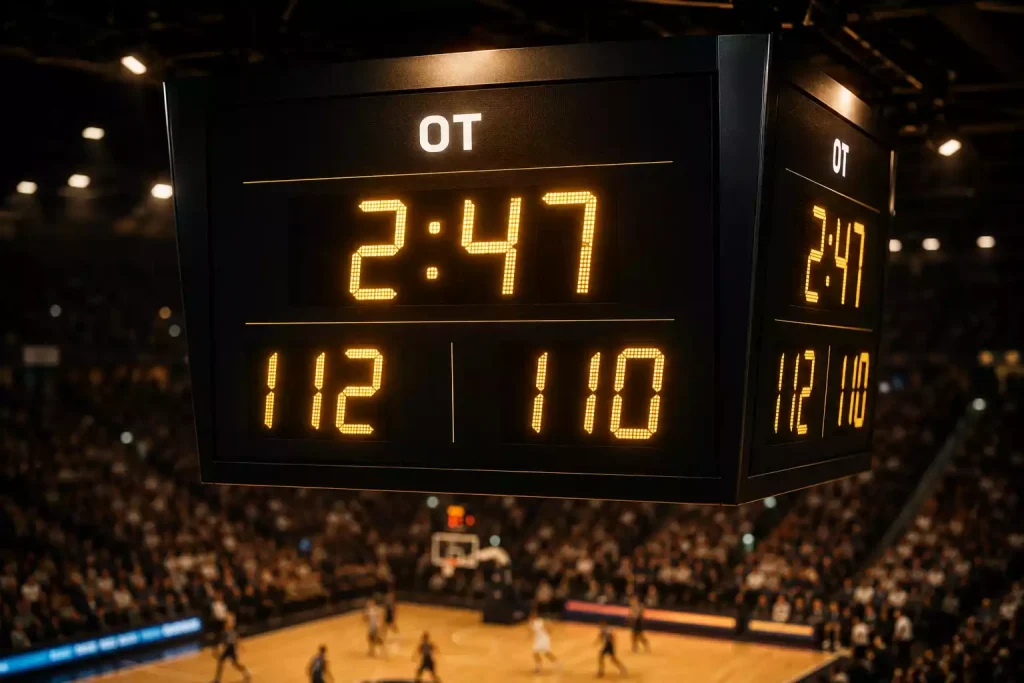
I once watched a bet that was comfortably winning flip to a loss in overtime. The team I’d backed on the spread was up by 8 with two minutes left in regulation, then gave up the lead, and in the five-minute overtime the other side pulled away. My spread bet settled on the final score including overtime, and what looked like a comfortable cover became a loss. In-play betting now accounts for 62.35% of online betting revenue globally, with growth exceeding 13% annually — and a significant portion of the disputes and confusion in basketball betting centre on one question: what counts when the game goes past 48 minutes?
This guide covers how overtime affects every major market type at UK bookmakers, where the settlement rules diverge between operators, and the specific scenarios that catch punters off guard. The US Senate Committee on the Judiciary has noted that the emergence of manipulation across multiple leagues suggests a deeper, systemic vulnerability in sports betting — and understanding settlement rules is part of protecting yourself from outcomes you didn’t anticipate.
Settlement Rules for Overtime Moneyline Bets
The moneyline is the simplest market to understand in overtime: whoever wins the game, including any overtime periods, wins the bet. There is no ambiguity here at any UK bookmaker. If a game goes to triple overtime and your team wins by one point, your moneyline bet pays out in full.
However, some bookmakers offer a separate “regulation time” moneyline market, where the result at the end of the fourth quarter determines the settlement. If the game is tied at that point, this market settles as a draw — which means three-way pricing (home/draw/away) rather than the standard two-way moneyline. The regulation time market is less common for basketball than for football, but it appears at some UK operators, particularly for NBA games. If you’re placing a moneyline bet and the market doesn’t explicitly state “including overtime,” check the terms. The standard assumption is full game including OT, but it costs nothing to verify.
The practical implication: overtime moneyline bets carry slightly higher variance than regulation-time bets because you’re exposed to additional playing time. A team that dominated four quarters can lose focus in OT, particularly if their star player picks up a fifth foul during regulation. If you’re betting moneyline on a team you expect to control the game but potentially fatigue late, the regulation-time market — where available — reduces your exposure to that scenario.
How Overtime Changes Point Spread and Totals Settlement
Spreads and totals are where overtime creates the most confusion and the most costly misunderstandings. The universal rule at UK bookmakers: point spread and totals bets are settled on the final score including all overtime periods. A game that finishes 112-108 after overtime settles with that score, not the score at the end of regulation.
This has direct consequences for spread bettors. The team that was covering a -6.5 spread with two minutes left in the fourth quarter may not be covering by the time overtime ends. Overtime periods are five minutes long and tend to produce 8-15 total points. If the game was tied at the end of regulation, the overtime period creates a fresh margin that could go either way — meaning your spread bet is essentially reset to a coinflip for those final five minutes.
For totals, overtime almost always pushes the combined score over the pre-game line. A game set at 215.5 that’s sitting at 206 combined with a minute left in regulation looks like it’s heading under — but if the game ties and goes to overtime, those additional 8-15 points will likely push the total well over. Roughly 6-7% of NBA games go to overtime in any given season, which is frequent enough that it should factor into your totals analysis. If you’re betting an under on a game where the teams are closely matched and overtime is plausible, you’re carrying a hidden risk that the pre-game total doesn’t account for.
Player Props in Overtime: Which Stats Count and Which Don’t
Player prop bets settle on the player’s total statistics for the entire game, including overtime. If a player has 19 points at the end of regulation and you backed over 20.5 points, overtime gives them additional minutes to clear the line. This is one of the few scenarios where overtime helps rather than hinders — a player prop that looked dead can revive if the game extends.
However, there are nuances. Some bookmakers offer “first half” or “first quarter” player props, and these are never affected by overtime — they settle on the stats accumulated during that specific period. Full-game player props, though, are always inclusive of overtime statistics. Minutes, which drive prop outcomes, increase in overtime by roughly 3-5 minutes for starters, giving them additional opportunities to accumulate points, rebounds, and assists.
The strategic implication for prop bettors: when a game goes to overtime, the over on player props becomes more likely for starters who play heavy minutes. If you’re betting in-play and a game is heading to OT, there’s an opportunity to back overs on player props that are currently sitting just below the line. The full range of basketball markets available at UK bookmakers includes player-level options where overtime scenarios create specific value windows.
Quarter and Half Bets: Why Overtime Doesn’t Apply
Quarter and half bets are the simplest overtime scenario: they’re completely unaffected. A first-quarter bet settles on the score at the end of the first quarter. A first-half bet settles on the score at halftime. No overtime period, regardless of how many occur, changes these settlements.
This clarity makes quarter and half bets attractive for punters who want to avoid overtime risk entirely. If your analysis is strong for specific periods — you’ve identified that a team starts slowly or finishes quarters strongly — betting on quarter markets removes the variable of overtime from your risk profile. The fourth quarter is the only period with any indirect connection to overtime: if the game is close, the final minutes of the fourth quarter will feature intentional fouling, timeouts, and pressure that can distort scoring patterns as teams try to force or avoid overtime.
How UK Bookmakers Differ on Overtime Settlement
The UK gambling industry generated gross gambling yield of £16.8 billion between April 2024 and March 2025, and the competitive landscape means operators occasionally differ on settlement rules for edge cases. While the core rules — moneyline includes OT, spreads include OT, totals include OT — are universal, differences emerge on less common markets.
Some operators offer “fourth quarter result” or “fourth quarter winner” markets that settle only on scoring during the fourth quarter (minutes 37-48), excluding overtime. Others define “fourth quarter” as everything after halftime’s second period through to the final whistle, which would include overtime. The difference is subtle but can change the settlement of your bet. Always check whether the market description explicitly references “4th period only” or “rest of game.”
Another variation: some bookmakers offer alternative totals or alternative spreads that settle differently in overtime compared to their main-market equivalents. These are rare but worth checking if you regularly bet on niche basketball markets. The safest approach is to treat the operator’s specific terms and conditions as the authority, not the general rules you’ve absorbed from experience. Bookmark the settlement rules page for each bookmaker you use, and revisit it whenever you encounter an unfamiliar market.
Does overtime count for over/under bets in basketball?
Yes. At all UK bookmakers, basketball totals bets are settled on the final score including any overtime periods. This means a game that appears headed under the line at the end of regulation can push over if it goes to overtime, since the additional five-minute period typically adds 8-15 combined points.
How do UK bookmakers settle spread bets that go to overtime?
Point spread bets in basketball are settled on the final score including overtime at all UK bookmakers. The margin of victory or defeat after overtime determines whether the spread is covered, regardless of the score at the end of the fourth quarter.
Are there any basketball markets that exclude overtime scoring?
Quarter bets, half bets, and specific period markets settle on scoring within their defined time frame and are not affected by overtime. Some bookmakers also offer a regulation-time moneyline market that settles on the score at the end of the fourth quarter. All other standard markets — full-game moneyline, spread, totals, and player props — include overtime.
Articles
Written by the editors at Betting Basketball UK.
