
Basketball Odds Comparison: Strategic UK Line Shopping
 Available in US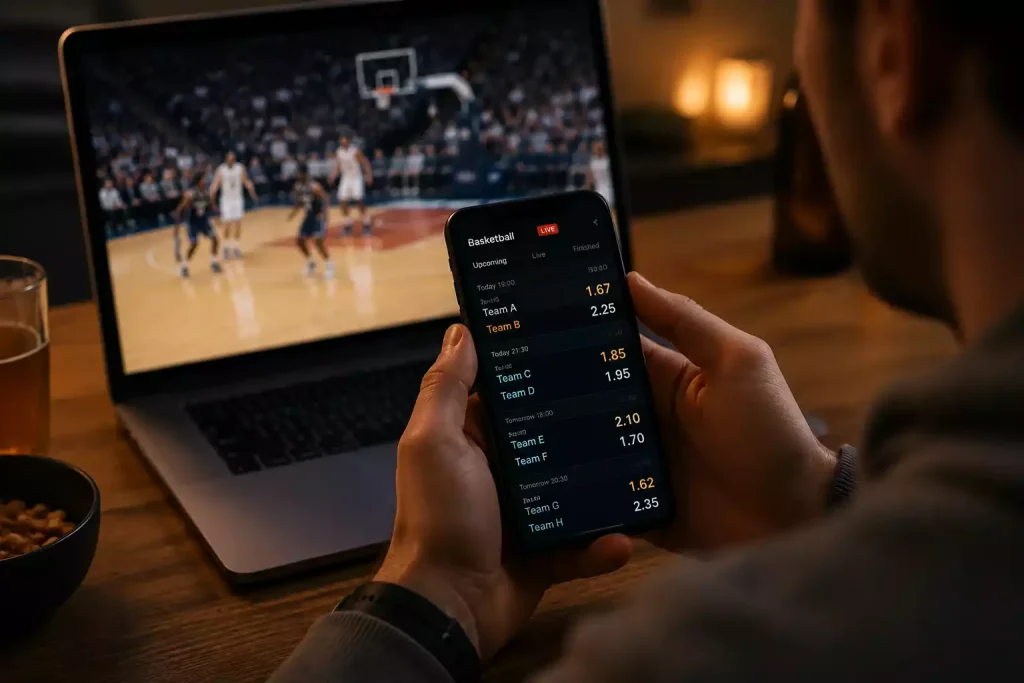
The easiest edge in basketball betting isn’t a model, a system, or inside knowledge — it’s comparing prices. The global basketball betting market is valued at $8.7 billion, served by hundreds of operators who each set their own odds based on their own models, their own risk exposure, and their own customer base. Those independent pricing processes produce genuine variation, and capturing the best available price on every bet is the single most reliable way to improve your long-term return.
I spent my first few years using one bookmaker for everything. When I finally opened accounts at four additional operators and started comparing lines, my yield improved by roughly 2% without changing my selection process at all. That 2% doesn’t sound dramatic until you compound it across hundreds of bets per season. This guide covers why basketball odds vary, how to compare them efficiently, the exchange versus sportsbook question, and the mathematical impact of consistent line shopping.
Understanding Market Models and Margin Variance
The UK remote gambling sector generated gross gambling yield of £7.8 billion in the year to March 2025, a 13.1% increase year-on-year. That growth has intensified competition between operators, and competition drives odds variation. NBA Commissioner Adam Silver has spoken about the need to balance engagement with regulation, noting the league takes sports betting seriously as something people enjoy doing while requiring guardrails. The market’s expansion means more operators pricing more games, and more pricing means more variation.
Each bookmaker sets odds using a combination of statistical models, trader adjustments, and market response. The base model produces an estimated probability for each outcome, which is then converted to odds with a margin (overround) added. That margin varies between operators — some compete on price with thin margins (3-4% overround), while others maintain wider margins (5-7%) and compete on other features like streaming, promotions, or market depth.
Beyond the margin, the odds differ because of exposure management. When a bookmaker takes heavy action on one side of a bet, they adjust the odds to attract action on the other side. This liability-driven adjustment is independent at each operator, which means one bookmaker might shade their line toward the favourite (because their customers backed the underdog) while another shades toward the underdog (because their customers backed the favourite). The same game can show meaningfully different NBA odds at different operators at the same time.
How to Compare Basketball Odds Efficiently
The manual approach — logging into five bookmaker accounts and checking each one — works but is slow. By the time you’ve compared all five, the line at the first operator may have moved. For NBA games with high liquidity, this is less of an issue because lines are stable for longer periods. For EuroLeague or BBL games, where lines are thinner, speed matters more.
Odds comparison tools aggregate prices from multiple bookmakers in real time, showing you the best available odds for each side of a market across operators. Several free tools serve UK punters, displaying decimal odds for all major basketball markets. The most useful comparison sites show not just the best current price but the historical line movement, which helps you assess whether you’re catching a line at its peak or after it’s already moved against you.
The practical workflow I use: check the comparison site for the best available price, open an account (or log in) at the operator offering the best odds, place the bet, and move on. For NBA spread bets, the difference between the best and worst available price among UK bookmakers is typically 0.03-0.05 in decimal odds (for example, 1.91 versus 1.95). That gap may seem trivial on a single bet, but it represents a 2-4% difference in implied value that accumulates over time.
Betting Exchanges vs Sportsbooks for Basketball Odds
Betting exchanges — where you bet against other punters rather than against the bookmaker — offer a fundamentally different pricing model. The exchange doesn’t set odds; the market does, through supply and demand. The exchange takes a commission (typically 2-5%) on net winnings rather than building a margin into the odds.
For basketball, exchange odds are often better than sportsbook odds, particularly for popular NBA markets. The commission structure means the effective overround is lower — often below 2% on liquid NBA markets, compared to 4-5% at traditional sportsbooks. For a bettor placing £10,000 worth of spread bets across a season, the difference between a 2% overround and a 5% overround is £300 in saved margin — money that goes directly to your bottom line.
The limitation of exchanges for basketball is liquidity. NBA Finals games and major playoff matchups attract substantial exchange liquidity, but regular-season games — particularly those involving smaller-market teams — may have limited availability. EuroLeague and BBL exchange liquidity is minimal, making sportsbooks the only practical option for those leagues. The hybrid approach is to use exchanges for high-profile NBA games where liquidity is deep and sportsbooks for everything else, comparing sportsbook odds using comparison tools to capture the best available price.
The ROI Impact of Consistent Line Shopping
Americans legally wagered $166.94 billion on sports in 2025, with sportsbook revenue reaching a record $16.96 billion. The gap between handle and revenue represents, in part, the margin that bettors pay. Line shopping directly reduces the margin you pay, which is equivalent to increasing your analytical edge without doing any additional analysis.
The mathematics are straightforward. A bettor placing 500 NBA spread bets per season at 1.91 (the standard -110 price) has an implied breakeven win rate of 52.38%. The same bettor consistently getting 1.95 instead of 1.91 reduces the breakeven win rate to 51.28%. That 1.1 percentage point difference means they need to win roughly six fewer bets out of 500 to break even — a meaningful advantage that requires no analytical improvement whatsoever.
Over a five-year career, the cumulative impact of line shopping dwarfs the impact of any individual bet selection. A bettor with a genuine 54% win rate on spread bets will produce a substantially different long-term result depending on whether they consistently bet at 1.91 or at 1.95. At 1.91, their expected yield is approximately 2.8%. At 1.95, it rises to approximately 4.9%. The difference is almost entirely attributable to the price at which the bets are placed, not the quality of the selections. For serious basketball bettors, line shopping isn’t an optimisation — it’s a requirement.
How much difference do basketball odds typically show between UK bookmakers?
For NBA spread bets, the typical difference between the best and worst available price among major UK bookmakers is 0.03 to 0.05 in decimal odds. For moneyline bets on favourites and underdogs, the variation can be larger — sometimes 0.10 or more on underdogs. EuroLeague and BBL odds tend to show wider variation due to less competitive pricing.
Is a betting exchange better than a sportsbook for basketball odds?
Betting exchanges generally offer lower effective margins on liquid NBA markets, with overrounds below 2% compared to 4-5% at traditional sportsbooks. However, exchange liquidity for basketball varies significantly — major NBA games have good liquidity, while regular-season games, EuroLeague, and BBL have limited exchange activity, making sportsbooks the more practical option for those markets.
How often should you compare odds before placing a basketball bet?
Ideally, every time. Building odds comparison into your standard betting workflow ensures you capture the best available price on every wager. For NBA spread and totals bets, checking 3-5 operators takes under a minute and can improve your long-term yield by 1-3 percentage points — a significant edge that requires no additional analytical work.
Articles
Written by the editors at Betting Basketball UK.
